
What to Include in a Year-End PPC Report for Lead Gen Accounts


After a relaxing holiday break, many marketers return to the office facing a daunting task – the dreaded year-end performance report.
The challenge can be even more difficult for lead gen accounts dealing with longer sales cycles and tracking challenges associated with full-funnel lead tracking.
If you're having a hard time knowing where to start, this blog post is here to help. I've outlined some ideas on what you should and shouldn’t include in an annual performance report for lead gen accounts, and have some general tips on what to keep in mind.
Consider Your Audience
Whenever you’re building a report, the most important thing to consider is who you’re building it for. Is your report only going to be seen by the marketing team? Or will the sales team, C-Suite, or board of directors also have access?
Some stakeholders may not be interested in traditional key performance indicators like CPCs, campaign types leveraged, or even the number of form submissions your campaigns generated. Or maybe they are! The content of your report should reflect what your audience wants to know about.
For those of us who work at agencies, it’s crucial to take ourselves out of the "all PPC all day" mindset. Talk to your main point of contact about what KPIs you should focus on for the report. Are there metrics like revenue and profit that you don’t typically report on that should be included? Do stakeholders outside of the marketing team use different terminology for certain KPIs? It may feel silly, but even asking if there are certain buzzwords that the CEO loves can be a huge help!
Have a Full-Funnel View
The goals set for lead gen accounts typically go beyond just generating leads. What clients really want is qualified prospects who they can turn into customers.
For accounts with longer sales cycles, the end of the year is a great time to look back at all of the leads that originated from PPC campaigns to see how many of them turned into qualified leads – or even customers. Even if your goal for campaigns is to get 300 marketing-qualified leads a month at less than $500 a lead, it’s important to show how your campaigns are contributing to actual business goals beyond in-platform goals.
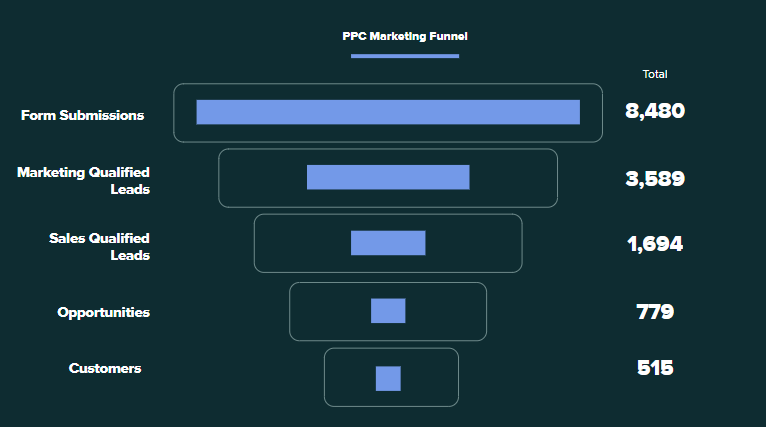
So, in addition to showing how you crushed your goals set by the marketing team, fight for sales data to help tell the story of how PPC efforts are contributing to company success.
Agree on Attribution
Have you settled on an attribution model with your team? If not, the end of the year is an excellent time to do that.
If you’re running campaigns across multiple ad platforms, there’s likely more than one marketing touch point that ultimately results in a new customer. For example, which ad platform should get the credit if someone visited your site after seeing a LinkedIn ad, but submitted a contact form after clicking on a branded Google Search Ad?
Before you build your year-end report, make sure all stakeholders agree on which touchpoint should ultimately get credit for a sale.
Showcase Return on Investment
Getting access to and including sales data in your report can help show how your PPC efforts contributed to real business outcomes. Consider reporting your return on investment or return on ad spend if possible.
If you work for an agency, your client may want to include your agency fees or even in-house marketing salaries in addition to billed ad spend when looking at ROI.
Keep in mind, clients generated from PPC campaigns could continue to drive revenue for subscription-based or service industries. Including projected lifetime value can help stakeholders understand how PPC efforts will contribute to company success moving forward.
Highlight Incrementality
Transparency is absolutely essential in reporting. When building PPC reports, make sure you specify how much you’re spending on truly incremental campaigns versus branded search campaigns or retargeting campaigns. Ideally, non-incremental leads will come in at a much lower cost per conversion than leads from prospecting campaigns.
Don't Forget Traditional PPC Metrics
After starting your report with the most important business results – like opportunities, customers, revenue, and profit – you may want to include in-platform PPC metrics to help tell the story of year-end performance.
For example, did ad spend increase this year as impression share increased in conquesting campaigns? Are CPCs up industry-wide, leading to an increase in CPA? Any metrics that help tell the story can be included. Just remember that in most cases, they shouldn’t be the main focus of your report.
Mention Factors Outside Your Control
As much as advertisers love to maintain control over campaigns, we have to face the reality that they do not live in a vacuum. If factors out of your control helped or hurt campaigns in the past year, include them in your report so stakeholders can see the whole picture.
Those factors may include:
Ad Platform Changes
Let’s face it, ad platforms are not what they used to be. It feels like Google and Meta are forcing advertisers to utilize AI-driven campaign types to remain competitive, and we don’t have access to the search term, audience, and placement data that we used to for many campaign types.
The recent introduction of brand inclusions in Google Ads makes it easier than ever to bid on your competitors' brand name, or for them to bid on yours. If any of the recent changes impacted campaigns, be sure to highlight this.
Business Changes
Sometimes things happen outside the ad platforms that can impact performance. For example, perhaps you introduced a new subscription tier over the past year. Or maybe you made changes to your email nurture flows or grew the sales team, leading to a better customer experience.
Whether it’s landing page changes, CRM updates, or a rebrand, make sure you include these updates in your report.
Competitive Changes
If changes to your competitive landscape had an impact on business, your campaigns will be impacted too. Make sure all of these details, like new government policies, are included in your annual report if they're important to the overall story of performance.
Include Future Recommendations
Whether you had a record-breaking sales year or struggled to meet your goal, there are always improvements that can be made to campaigns or new strategies to test. Make sure your report includes recommendations for how you can improve performance in the year ahead.
Even if there are changes impacting performance outside of your control, think of how you can get creative to overcome these challenges. Perhaps you need to increase spending on conquesting efforts after a new competitor entered the market, or test a new ad platform to see if you can generate more top-of-funnel awareness.
Revisit Your Goals
As a new year begins and another ends, it’s also a great time to reflect on the goals that were set over the past year and determine if they were too conservative or too ambitious.
One of our biggest recommendations for lead gen moving forward is integrating with CRM platforms to optimize campaigns for lower-funnel leads, like Marketing Qualified Leads (MQLs), Opportunities, or even Customers. This can be a game-changer for campaigns, but the integration can be difficult to set up, especially if you work at an agency and can't access your clients' CRM.
The Bottom Line
Even if you’ve been told “no” before, the new year is a great time to ask again! Year-end reports are an excellent opportunity to pitch new ideas to stakeholders you may not typically interact with.
Looking to boost your lead gen efforts in 2026? Get in touch to learn how Cypress North can help!
Meet the Author

Christine Zirnheld
Christine is our Director of Lead Gen and a co-host on our weekly Marketing O’Clock podcast. Known affectionately among coworkers and podcast listeners as Shep, she joined Cypress North in 2018 and works out of our Buffalo office.
As Director of Lead Gen, Christine oversees all of our lead generation clients, providing strategic guidance and assistance as needed to ensure we’re hitting their goals. She is on the cutting edge of paid search strategy and uses her expertise to not only uncover more quality leads for clients, but to turn those leads into customers.
Christine is an established thought leader in the digital marketing community, known for her PPC expertise and strategic mindset. She was recognized as one of the Top 50 Most Influential PPC Experts of 2025 by PPC Survey. Christine has shared her insights as a speaker at several major digital marketing conferences, including SMX Advanced in Boston, SMX London, and SMX Next. She has contributed to Search Engine Journal and Search Engine Land, and even published an ultimate playbook for Google Ads.
Originally from Ashburn, Virginia, Christine graduated from Canisius University with a bachelor's degree in marketing. She also has an associate's degree in fashion business management from the Fashion Institute of Technology.
When she’s not working, Christine can be found singing karaoke or watching Miss Rachel with her toddlers, watching Bravo, dining al fresco, and drinking Diet Coke. She’s known for making her Taylor Swift fandom her personality, talking about the royal family to any of her coworkers who will listen, and reading books about wives who kill their husbands. Christine was the 2002 Hula Hoop Champion at Ashburn Elementary School – and may still be undefeated.